
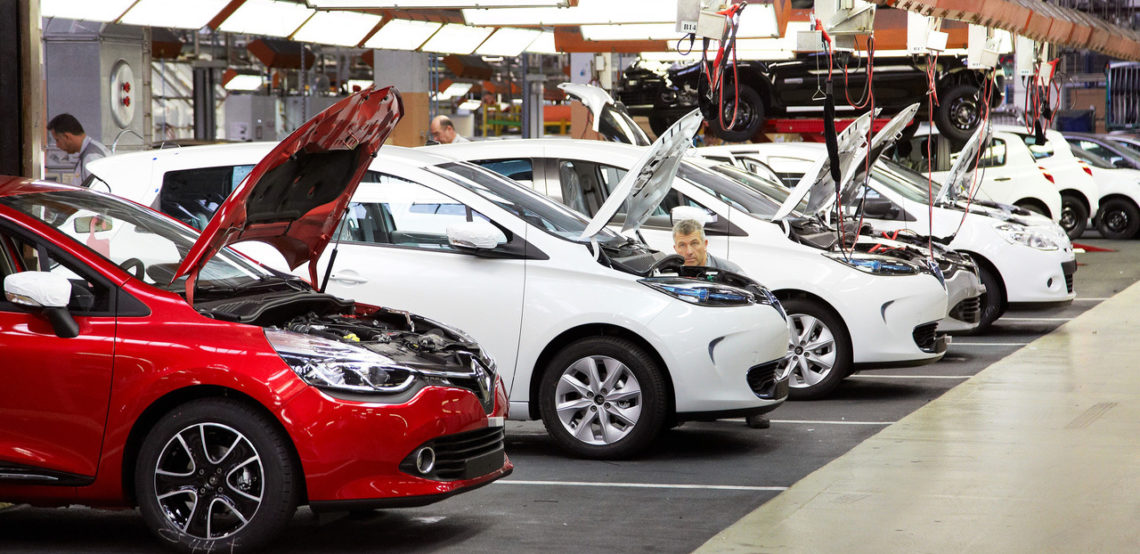
European industry is entering a period of structural stress. Production volumes are declining, long-established plants are operating below capacity, Asian competitors are gaining ground, and environmental requirements are becoming more demanding. Across automotive, electronics and household appliances, Europe’s industrial backbone is weakening. In France, Germany and Italy alone, more than 50 major industrial sites are now considered vulnerable or exposed to potential closure.
This industrial transition, while challenging, also opens up new strategic options. Converting existing plants into circular economy hubs offers a credible alternative-one that preserves industrial jobs while rebuilding local, low-carbon and more resilient value chains.
Reindustrialising through circular models
Recent sector data highlights the scale of the challenge.
European light vehicle production declined from 21 million units in 2019 to 17 million in 2024, a 19% decrease. Over the same period, vehicle imports from China surged by more than 1,500%, making China the leading source of vehicle imports into the European Union.
In household appliances, European manufacturing capacity continues to contract, while China exported 4.48 billion units in 2024 alone, up 21% year on year.
In electronics and ICT, European players saw revenues fall by 7% in 2024, as China now accounts for 40% of global market share.
This competitive pressure is already translating into partial closures, reduced activity and, ultimately, the emergence of industrial brownfields.
At the same time, a powerful countertrend is reshaping the landscape. The circular economy is becoming a cornerstone of European industrial and regulatory policy. It is embedded in major frameworks such as the 2024 Ecodesign for Sustainable Products Regulation, the 2025 Waste Directive, and the upcoming Circular Economy Act expected in 2026. Ecodesign, repair, reuse, refurbishment, remanufacturing and recycling are no longer peripheral initiatives; they are becoming core economic and regulatory requirements, paving the way for a true single market for secondary raw materials.
More than 50 industrial sites with conversion potential in France, Italy and Germany
Across automotive, household appliances, chemicals and paper, more than 50 large industrial sites in France, Italy and Germany are facing declining volumes or restructuring risks. France is seeing growing fragility across automotive, aerospace and electronics plants. Italy faces similar pressures in household appliances and mechanical industries. Germany, heavily exposed through its automotive and chemical sectors, is also seeing several emblematic sites lose momentum.
Many of these plants are ageing and underutilised, yet they represent valuable industrial assets. Their infrastructure, logistics and workforce make them well suited to host circular activities such as refurbishment, dismantling, parts reuse and advanced recycling.
The Renault Flins case: circularity at industrial scale
The most advanced example in Europe is Renault Group’s Flins site, transformed in 2021 into the Refactory of Flins-the first industrial site fully dedicated to circular mobility activities. Formerly focused on linear vehicle production, the plant has been reconfigured into a multi-activity, multi-brand and multi-company circular ecosystem. This platform now underpins The Future Is Neutral’s operations, including its subsidiaries THE REMAKERS and GAIA, as well as its consulting activities and innovation hub.
The impact is already tangible. Jobs have been preserved, with new permanent hires underway. The site processes more than six million parts annually, has refurbished over 50,000 vehicles since 2022, remanufactured 350,000 parts and reused 3,000 batteries in 2024 alone. In just a few years, Flins has shifted from an end-of-cycle factory to a fully integrated industrial platform combining repair, refurbishment, reuse and recycling.
This transformation demonstrates that an industrial site in transition can once again become a strategic asset by aligning industrial performance with low-carbon activities.
Other industrial groups are beginning to follow this path. In 2025, Groupe SEB, for example, announced the conversion of its Is-sur-Tille site in eastern France into its first European centre dedicated to the refurbishment of electrical products, complementing its long-standing role as a global centre of expertise.
A complex industrial and human transformation
Converting an industrial site to circular activities remains a demanding process. It requires a clear economic model, secure flows of products and materials, strong industrial partnerships, adapted tooling and, critically, significant workforce upskilling. Success depends on the ability to combine strategic clarity with operational execution.
This is the ambition behind the collaboration between Do Well Do Good (DWDG) and The Future Is Neutral. Together, they offer an end-to-end approach that combines strategic analysis, industrial modelling and structuring with hands-on operational experience drawn from real transformation projects-of which the Refactory of Flins has become a European reference.
The Future Is Neutral delivers circular economy solutions for the automotive industry:
- Mission: collect and dismantle end-of-life vehicles; reuse, remanufacture or recycle parts and materials; and reintegrate them into the automotive value chain.
- Resource: a pool of approximately 11 million end-of-life vehicles generated each year in Europe.
- Commitment: industrial competitiveness, reduced environmental impact, sovereignty and innovation.
- Foundation: the combined expertise of its two shareholders-Renault Group in automotive manufacturing and SUEZ in waste management.
For many at-risk industrial sites, circular conversion is no longer a theoretical concept. It is a practical, credible option to preserve jobs, strengthen industrial sovereignty and build new value chains aligned with Europe’s strategic priorities. The challenge for industrial leaders is not simply how to manage decline, but how to select and implement models capable of giving existing industrial assets a renewed and sustainable role.